The Australian Idea of a University by Glyn Davis
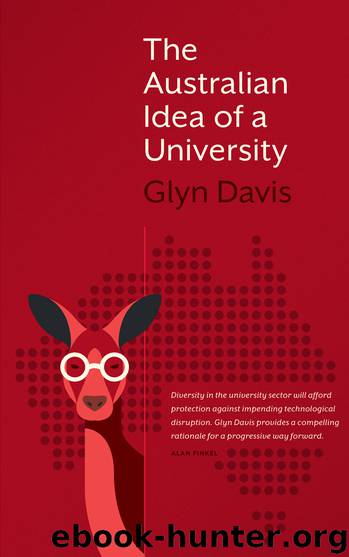
Author:Glyn Davis [Davis, Glyn]
Language: eng
Format: epub
Tags: Education, General, Educational Policy & Reform
ISBN: 9780522871753
Google: 9pc9DwAAQBAJ
Publisher: Melbourne University Publishing
Published: 2017-11-10T01:05:59.599000+00:00
THE DAWKINS MOMENT
Minister Dawkins understood the power of policy to remake a system. The ministerial title he adopted— placing ‘education’ after ‘employment’—underlined that university reform would focus on human capital, with explicit economic objectives. Higher education, he argued, must be ‘more responsive to the needs of industry, more flexible, more consistent with “national interests and objectives”’.4 By the time Dawkins left the portfolio in December 1991 to become treasurer, it was a much altered higher education landscape.5
Simon Marginson, Professor of International Higher Education at the Institute of Education, University College London, offered a bracing assessment of ministerial craft:
What Dawkins did was strengthen the normalisation process by systematising the norm of the Australian idea, using the powerful device of competitive emulation to entrench it, while at the same time stepping away from, and/or actively preventing, all forms of state sanctioned diversity of mission and approach, whether binary sector, disciplinary specialist institution, or sanctioned experimentalism.6
The new minister listened carefully to concerns from institutes and colleges about their status. Such arguments could be yoked to the minister’s aspiration to expand enrolments. By abolishing the binary divide, and extending university status to a wider array of institutions, the minister would double university places. National protocols would define a university and regulate its operations, creating what the minister called a ‘unified national system’ of higher education.
The Dawkins reforms adopted the familiar template of an Australian metropolitan university and compelled all institutions to conform. The loss of small specialist colleges accentuated similarities. Henceforth, Australian higher education would operate with a single set of funding rates and a preference for three-year undergraduate degrees, using the programs, titles, nomenclature and operating procedures of the nation’s founding institutions.
The unified national system accepted only one idea of a university and made it the national standard. The raft of new universities that emerged from the Dawkins reforms were designed in this single image, each a public self-governing institution established through legislation, strongly tipped towards educating the professions, meritocratic, non-residential and comprehensive, with a mission that required teaching and research. They joined existing players already shaped by the Australian tradition.
To fund these changes, the minister ended a fifteen-year experiment with free tertiary education. Undergraduates would now pay fees once earning a salary through a Higher Education Contribution Scheme (HECS). The minister had already allowed universities to charge up-front fees to international students. In time, this would create a huge export industry for Australia, and allow government to reduce financial support for universities.
Minister Dawkins stressed efficiency, and imposed a new minimum size requirement. The Commonwealth would support only research institutions with at least 8,000 full-time students. This meant an end to the independent art schools and music conservatoria, along with the rural and fashion colleges surviving on the periphery of tertiary education. Their demise ended the distinctive educational experience possible only in a small and specialised institution.7 Some became part of the TAFE sector, but those aspiring to university status faced a difficult decision. Twenty-one institutions failed to meet the size threshold. Their
Download
This site does not store any files on its server. We only index and link to content provided by other sites. Please contact the content providers to delete copyright contents if any and email us, we'll remove relevant links or contents immediately.
The Art of Coaching Workbook by Elena Aguilar(51135)
Trainspotting by Irvine Welsh(21606)
Twilight of the Idols With the Antichrist and Ecce Homo by Friedrich Nietzsche(18599)
Fangirl by Rainbow Rowell(9210)
Periodization Training for Sports by Tudor Bompa(8236)
Change Your Questions, Change Your Life by Marilee Adams(7716)
This Is How You Lose Her by Junot Diaz(6854)
Asking the Right Questions: A Guide to Critical Thinking by M. Neil Browne & Stuart M. Keeley(5734)
Grit by Angela Duckworth(5575)
Red Sparrow by Jason Matthews(5446)
Paper Towns by Green John(5161)
Room 212 by Kate Stewart(5087)
Ken Follett - World without end by Ken Follett(4705)
Housekeeping by Marilynne Robinson(4419)
The Sports Rules Book by Human Kinetics(4365)
Double Down (Diary of a Wimpy Kid Book 11) by Jeff Kinney(4252)
Papillon (English) by Henri Charrière(4236)
The Motorcycle Diaries by Ernesto Che Guevara(4069)
Exercise Technique Manual for Resistance Training by National Strength & Conditioning Association(4048)
